
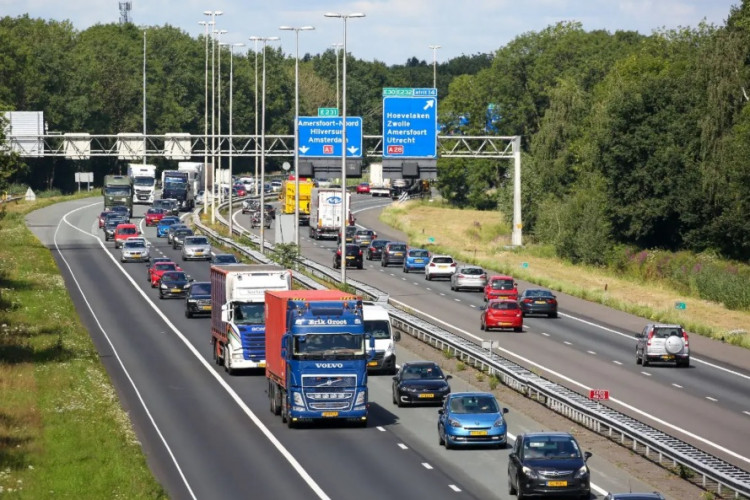
Truck sales fell across Europe in 2025, but the bigger story is what didn’t change. Despite all the talk about electrification, 93% of new trucks still ran on diesel.
Europe’s road freight sector faced another difficult year in 2025. New truck registrations across the European Union fell by 6.2% compared with the previous year, confirming that fleet investment remains under pressure amid weak economic conditions and high operating costs. While electrically chargeable trucks continued to gain ground, the latest figures show that the transition is progressing unevenly — and remains largely confined to a small number of markets and use cases.
Across the EU, just over 307,000 new medium and heavy trucks were registered in 2025. Almost all of them were diesel-powered. Despite growing political focus on zero-emission freight, diesel still accounted for more than 93% of all new truck registrations, underlining how limited the practical alternatives remain for most hauliers.
Falling demand reflects delayed fleet renewal The contraction in truck registrations was visible across most major markets. Germany and France, the EU’s two largest truck markets, both recorded year-on-year declines, with Germany seeing a double-digit fall in total registrations. Spain and Italy also posted lower volumes, while growth in Central and Eastern Europe remained uneven.
For freight operators, the trend points less to structural change and more to postponed investment. With transport demand under strain and costs still elevated, many companies appear to be extending the life of existing vehicles rather than committing to large-scale fleet renewal.
How the picture looks in key freight markets A closer look at individual countries shows that Europe’s diesel-heavy truck market is not uniform — but neither is the shift towards alternative drivetrains.
Germany: Europe’s largest truck market, cautious electrification Germany remained the EU’s largest truck market in 2025, with 77,431 new medium and heavy trucks registered. Diesel continued to dominate, accounting for 71,342 vehicles, while 4,766 electrically chargeable trucks entered service.
Electric uptake was concentrated in the medium truck segment, where electric models accounted for a noticeable share of registrations. In the heavy truck category, however, electric vehicles remained marginal, underlining the difficulty of electrifying long-haul freight even in Europe’s most advanced market.
United Kingdom: electric growth driven by medium trucks The UK registered 54,119 new trucks in 2025, with diesel accounting for more than 92% of the total. Electric trucks reached 3,023 units, but almost all of them were medium-duty vehicles.
In the heavy truck segment, electric registrations remained extremely limited, while alternative drivetrains grouped under “other” — mainly hybrids — accounted for 929 vehicles. This points to targeted use cases rather than broad fleet transition.
France: higher share of alternatives, diesel still central France recorded 46,079 new truck registrations in 2025. Diesel remained dominant, but France stood out for its relatively higher number of trucks registered under “other” drivetrains (4,025 units), alongside 1,713 electric trucks.
However, this diversity did not fundamentally alter the market structure. Heavy trucks continued to rely overwhelmingly on diesel, while alternative drivetrains were largely confined to specific segments and supported projects.
Spain: limited electrification, diesel firmly in control Spain registered 30,989 new trucks, with diesel accounting for almost the entire market. Only 502 electric trucks were registered across both weight categories, representing a very small share of total volumes.
Even in the medium segment, electric trucks remained an exception, highlighting the slow pace of transition in a market dominated by long-distance and price-sensitive freight operations.
Poland: growth market, almost entirely diesel Poland’s truck market reached 29,946 registrations in 2025, with diesel accounting for 29,554 vehicles. Electric trucks remained negligible, with just 178 units registered across both segments.
The figures underline a broader trend in Central and Eastern Europe, where fleet renewal continues but almost exclusively with conventional drivetrains.
Italy: electric presence limited to niche use cases Italy registered 27,709 new trucks in 2025. Diesel accounted for more than 96% of the total, while electric trucks reached 600 units, mainly in the medium segment.
In the heavy truck category, electric vehicles remained marginal, reinforcing the structural challenge of deploying zero-emission solutions in long-haul operations.
Romania and Hungary: diesel-only markets in practice Romania and Hungary illustrate the extreme end of the spectrum. Romania registered 8,703 new trucks, almost all of them heavy-duty diesel vehicles, with just 55 electric trucks recorded. Hungary registered 5,353 trucks, including only 54 electric vehicles.
In both markets, electric trucks remain statistically insignificant, reflecting lower margins, longer routes and limited charging infrastructure.Diesel remains the backbone of road freight
Country-level data shows that diesel’s dominance is not just an EU-wide average but a consistent pattern across individual markets. In Germany and the United Kingdom, diesel still accounts for more than nine out of ten newly registered trucks. In Spain, Italy and Poland, the share is even higher. In markets such as Romania and Hungary, new truck registrations remain almost entirely diesel-based.


